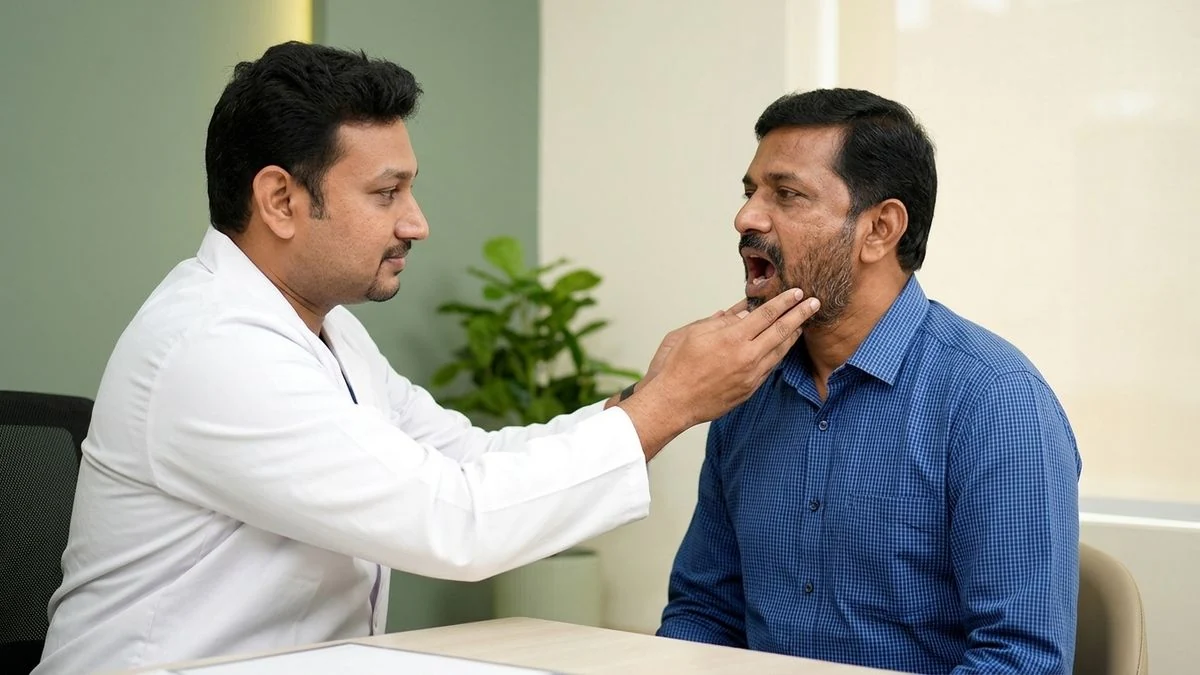
Apollo Main Hospital, Greams Road, Thousand Lights, Chennai · Dr. Pradeep S. & Dr. Kalpa Pandya
Gum (gingival / alveolar) cancer sits directly on the jaw bone, so it can reach bone early. Wide excision with the right extent of jaw surgery, neck dissection where needed, and same-sitting reconstruction restore chewing and appearance.
A sore on the gum that will not heal, a tooth that has gone loose for no reason, or an extraction socket that never closed — these are the ways gum cancer usually shows itself. Because they look like ordinary dental problems, many people are first seen by a dentist, and some have had a tooth removed before anyone suspects cancer.
Gum cancer (gingival or alveolar ridge cancer) is cancer of the lining that covers the upper or lower jaw around the teeth. That lining is thin and sits directly on bone, so gum cancer can reach the jaw earlier than cancers of the tongue or cheek. This is why the most common question we hear is: will I lose my jaw? Often the jaw can be preserved, or the removed part rebuilt in the same operation, depending on how far the cancer has gone.
Gum cancer often mimics everyday dental problems. See an oral cancer surgeon rather than waiting if you notice:
A non-healing ulcer or growth: A sore, lump, or red or white patch on the upper or lower gum that has not healed within two to three weeks.
Loose teeth without gum disease: One or more teeth in the same area becoming loose when the rest of your gums are healthy.
A socket that does not heal: A tooth extraction site that keeps bleeding, fills with soft tissue that grows, or has not closed several weeks after the extraction.
Dentures that stop fitting: A denture that suddenly rubs, rocks or causes a sore that does not settle when adjusted.
Bleeding, swelling or numbness: Unexplained bleeding from one area of the gum, swelling of the jaw, or numbness of the lower lip or chin, which can mean the nerve inside the jaw is involved.
Any of these can have a harmless cause, but the only way to be sure is an examination and, if needed, a biopsy. Our guide to whether a mouth ulcer can be cancer explains how we tell them apart.
Why Gum and Gingivobuccal Cancers Are So Common in India
In India, cancers of the lower gum and the groove between the gum and cheek (the gingivobuccal sulcus) are among the most common oral cancers. The main reason is where chewing tobacco, gutka, paan and areca nut are held: tucked against the lower gum and cheek for long periods, the same spot day after day.
Smoking, alcohol, and long-standing pre-cancerous changes such as leukoplakia and oral submucous fibrosis add to the risk. Gum cancer can also occur in people who have never used tobacco, so a persistent gum lesion should never be dismissed because of that alone — see oral cancer in non-smokers.
Because the gum and cheek sit side by side, cancer in this area often involves both. Cancer that starts in the inner cheek is covered on its own page about buccal mucosa cancer treatment, and cancer behind the last molar in our guide to retromolar trigone cancer.
How Gum Cancer Is Diagnosed and Staged
Diagnosis has two goals: to confirm the cancer and to find out exactly how far it has gone into the jaw and neck, because that decides the operation.
Biopsy
A small piece of the suspicious area is removed under local anaesthetic and examined under a microscope. It is quick, and it is the only way to confirm cancer. Our oral cancer biopsy guide explains what happens.
Scans of the jaw
A CT scan is usually the key test for gum cancer because it shows whether the bone is eroded and how deeply. MRI may be added to judge soft tissue spread or bone marrow involvement, and an OPG (panoramic dental X-ray) is often done early. PET-CT is reserved mainly for advanced disease — our guide to PET-CT vs MRI vs CT for oral cancer explains which scan is used when.
Neck examination
The lymph nodes in the neck are examined and scanned, because they are where oral cancer spreads first. What this means for staging is explained in neck lumps and lymph node spread in oral cancer.
Gum Cancer Surgery: Saving or Rebuilding the Jaw
Surgery is the main treatment for gum cancer. The aim is to remove the cancer with a margin of healthy tissue all round, including bone where needed, while keeping as much of the jaw as is safe. Which operation you need depends on whether the cancer is on the lower or upper gum and how far it has gone into bone.
Wide excision with marginal mandibulectomy (lower gum): When the cancer is close to the jaw or only touching its surface, the tumour is removed with a rim of the jaw bone, leaving the lower jaw continuous. The jaw line is kept.
Wide excision with segmental mandibulectomy (lower gum): When the cancer has gone into the bone, a full section of the jaw is removed to clear it, and that section is rebuilt in the same operation. Our mandibulectomy surgery page describes both approaches in detail.
Partial maxillectomy (upper gum): Upper gum cancer is removed with the part of the upper jaw it involves, sometimes including part of the palate; the gap is closed with a prosthetic plate (obturator) or a flap. See maxillectomy surgery.
Neck dissection: The lymph nodes in the neck are removed on the side of the cancer, both to treat any spread and to stage the disease accurately. See neck dissection surgery.
When the cancer has spread widely through the jaw, cheek and neck, these are combined into a single composite resection.
Reconstruction and Dental Rehabilitation
When part of the jaw is removed, it is rebuilt during the same operation so that you can chew, swallow and speak, and your face keeps its shape. The options are planned before surgery, not decided afterwards.
PMMC flap: A flap of muscle and skin from the chest, kept attached to its own blood supply, used to cover soft tissue defects. See PMMC flap reconstruction.
Free fibula flap: When a segment of the lower jaw is removed, bone from the lower leg is shaped into a new jaw and its blood vessels are joined under a microscope. This is done with our reconstructive colleague. See fibula free flap jaw reconstruction.
Dental rehabilitation: Once healing and any further treatment are complete, missing teeth can be replaced with a denture or, in suitable cases, implants placed into the rebuilt jaw. Dr. Kalpa Pandya, whose interests include implant rehabilitation, plans this stage — see dental implants after oral cancer.
Small gum cancers with clear margins and no spread to the neck are often treated with surgery alone. Radiotherapy is advised after surgery when the final pathology report shows features such as bone invasion, close or positive margins, nerve invasion or cancer in the lymph nodes; chemotherapy is added to radiotherapy for the highest-risk features.
These treatments are given by radiation and medical oncologists, and the plan is agreed together before surgery wherever possible. Because radiation affects the jaw bone, any teeth that are unlikely to survive are dealt with beforehand — see dental treatment before radiotherapy and will I need radiation or chemo after surgery?.
What Affects the Cost of Gum Cancer Treatment
There is no single price, because gum cancer treatment varies a great deal between patients. The main factors are:
Extent of jaw surgery: A marginal mandibulectomy is a smaller operation than a segmental mandibulectomy or a maxillectomy.
Reconstruction: A PMMC flap, a free fibula flap or an obturator each differ in operating time and hospital stay.
Neck dissection: Whether one or both sides of the neck are treated.
Hospital and intensive care stay: Usually longer after free flap reconstruction.
Further treatment and dental rehabilitation: Radiotherapy, chemotherapy, dentures or implants.
Clear answers make the decision easier. Questions worth asking include:
Bone: Has the cancer gone into the jaw bone, and does that mean a marginal or segmental mandibulectomy?
Reconstruction: How will the jaw be rebuilt, and where will the tissue come from?
Teeth: Which teeth will be removed, and how will they be replaced later?
Neck: Will the neck be treated, and on one side or both?
Further treatment: How likely is radiotherapy, and what would make it necessary?
If you have already been advised surgery elsewhere, an oral cancer second opinion can help you weigh the plan.
Gum Cancer Surgery in Chennai: What to Expect at Apollo Main Hospital, Greams Road
Your care is led by Dr. Pradeep S., an oral and maxillofacial surgeon with a fellowship in head and neck surgical oncology, international board certification (FIBCSOMS) and more than 15 years of experience in oral cancer surgery, including three years in the Department of Head and Neck Oncology at Apollo Proton Cancer Centre. He works with Dr. Kalpa Pandya, and both consult at Apollo Main Hospital, Greams Road.
Treatment decisions are made together with radiation and medical oncologists, pathologists and the reconstructive team, so that surgery, reconstruction and any further treatment happen in the right order.
Many of our patients travel from other parts of Tamil Nadu, West Bengal and Bangladesh. Dr. Pradeep S. consults in English, Tamil, Hindi, Telugu and Bengali, and you can send your reports and scans for review before you travel — see our page for patients from Bangladesh and West Bengal.
To discuss your diagnosis, call +91 96633 03747 or book a consultation at Apollo Main Hospital, Greams Road.
Finding us in Chennai
Mouth Cancer Surgeons is the practice of Dr. Pradeep S. and Dr. Kalpa Pandya, who consult at Apollo Main Hospital, Greams Road, Chennai. Patients come to us for gum cancer treatment from across Tamil Nadu, West Bengal and Bangladesh, and we offer remote review of reports and scans for those who need to plan travel.
Frequently asked questions
What are the early signs of gum cancer?
The most common early signs are a gum ulcer or growth that has not healed within two to three weeks, teeth becoming loose in one area without gum disease, an extraction socket that does not heal, a denture that suddenly stops fitting, and unexplained bleeding or numbness of the lower lip or chin.
Is gum cancer curable?
Yes, gum cancer is often curable, especially when treated early. Small cancers without spread to the neck are usually cured with surgery. More advanced cancers that involve the jaw bone or lymph nodes need larger surgery and often radiotherapy afterwards, and many are still treated with the intent to cure.
Will I lose my jaw during gum cancer surgery?
Not necessarily. If the cancer is close to the jaw but has not gone into the bone, a marginal mandibulectomy removes only a rim of bone and keeps the jaw continuous. If the bone is invaded, a segment is removed and rebuilt in the same operation, usually with a fibula free flap.
Can gum cancer be mistaken for gum disease or a tooth problem?
Yes. Gum cancer can look like gum infection, a dental abscess or a slow-healing extraction, which is why it is sometimes found late. A gum lesion or loose tooth that does not respond to normal dental treatment within a few weeks should be biopsied.
How is upper gum cancer treated differently from lower gum cancer?
Lower gum cancer is treated by removing the tumour with part of the lower jaw (marginal or segmental mandibulectomy). Upper gum cancer is treated with a partial maxillectomy, and the opening into the nose or sinus is closed with a prosthetic obturator or a flap.
Will I need radiotherapy after gum cancer surgery?
Not always. Radiotherapy is usually advised when the final report shows bone invasion, close or positive margins, nerve invasion or cancer in the lymph nodes. It is given by a radiation oncologist as part of one agreed treatment plan.
Can I have teeth replaced after gum cancer surgery?
Yes. Once healing and any radiotherapy are complete, teeth can be replaced with a denture or, in suitable patients, dental implants placed into the reconstructed jaw. Timing depends on your healing and on whether radiotherapy was given.
How long is the hospital stay after gum cancer surgery?
It depends on the extent of surgery. A smaller excision may need only a few days, while a mandibulectomy with free flap reconstruction often needs a week or more in hospital, followed by several weeks of recovery at home.
What does gum cancer treatment cost in Chennai?
The cost depends mainly on the extent of jaw surgery, the type of reconstruction, neck dissection, hospital stay, and whether radiotherapy or dental rehabilitation is needed. You receive an estimate once your biopsy and scans are reviewed; confirm insurance coverage with your insurer and the hospital insurance desk before admission.
Can I get a second opinion on gum cancer before travelling to Chennai?
Yes. You can send your biopsy report and scans for remote review. We will tell you whether more tests are needed, what surgery is likely and how long to plan to stay.
Who treats gum cancer at Mouth Cancer Surgeons?
Dr. Pradeep S. (Consultant, Oral & Maxillofacial Surgeon — specialist in oral, head and neck cancer surgeries) and Dr. Kalpa Pandya (Consultant, Oral & Maxillofacial Surgeon — specialist in OPMD, Facial Trauma, Dental Implants). You are cared for by the same two specialists from diagnosis through recovery.
Where do you consult in Chennai?
We consult and operate at Apollo Main Hospital, Greams Road.