
Dental Treatment Before Radiotherapy: A Patient Guide
Need expert consultation? Book an appointment with Dr. Pradeep S. or Dr. Kalpa Pandya.
Book AppointmentIf you have been told you need radiation for mouth or head and neck cancer, one of the most useful things you can do before the first session has nothing to do with the tumour: it is dental treatment before radiotherapy. A planned dental check, and sometimes removal of failing teeth, protects your jawbone from complications that are far harder to treat once radiation is over. This guide explains what dental clearance before radiation involves, why timing matters, and how to look after your teeth during and after treatment.
Why Your Teeth Matter Before Head and Neck Radiotherapy
Radiation does not distinguish between cancer cells and the healthy tissue in its path. When the jaw lies in the radiation field, its small blood vessels and bone-forming cells are damaged. The bone survives, but its ability to heal is permanently reduced.
That matters because teeth are a common source of infection. A decayed tooth, an abscess or advanced gum disease that is left untreated may later need extraction. Pulling a tooth from irradiated bone can leave a wound that never heals, leading to osteoradionecrosis (ORN): an area of dead, exposed jawbone. Our detailed guide to osteoradionecrosis of the jaw covers the condition itself.
Dental clearance is therefore not about cosmetic dentistry. It is about making the mouth stable and infection-free before radiation begins, as part of multidisciplinary cancer care.
Who Is Involved and How the Timing Fits
Dental planning before radiation is a team effort. The people usually involved are:
- Radiation oncologist: plans the radiation field and dose, and shares which parts of the jaw will receive the highest dose.
- Head and neck surgeon: removes the cancer and, where needed, rebuilds the jaw or tongue; often an oral and maxillofacial surgeon.
- Dentist or oral surgeon: examines the teeth, treats what can be saved and removes teeth with a poor outlook.
- Prosthodontist: designs fluoride trays, dentures and obturators (plates that close a gap in the upper jaw) and plans later tooth replacement.
- Speech and swallowing therapist and dietitian: help keep eating, swallowing and mouth opening on track during and after treatment.
The timing depends on whether radiation is the main treatment or follows surgery.
- Radiation as the main treatment: the dental work has to fit before the first radiation session, ideally leaving about 2 weeks for extraction sites to heal.
- Surgery first, then radiation: postoperative radiotherapy (PORT) should ideally start within about 6 weeks of surgery. Dental planning therefore begins before the cancer operation. In many centres, teeth that clearly need removing are taken out during the cancer surgery under the same anaesthetic, so the sockets heal during the post-operative recovery period rather than delaying radiation.
Either way, the earlier the dental assessment happens, the less likely it is to hold up cancer treatment.
The Pre-Radiotherapy Dental Check: What Is Examined
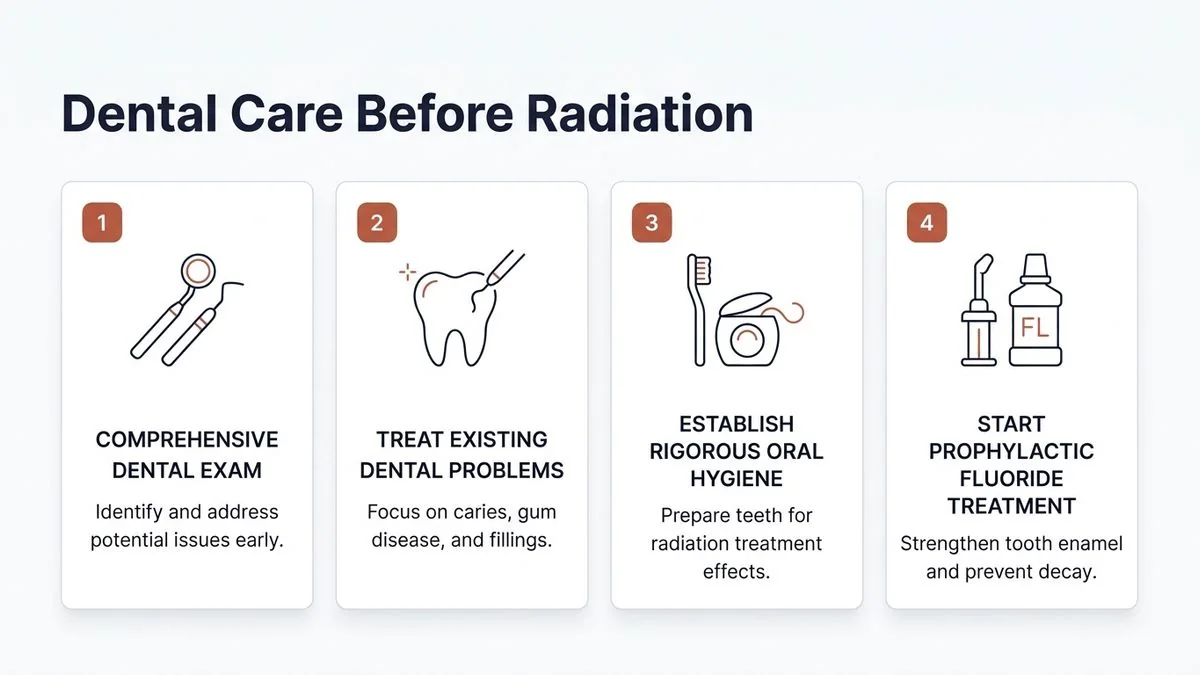
The dental assessment before radiation is more thorough than a routine check-up. It usually includes:
- A panoramic X-ray (OPG) of both jaws to show every tooth root, buried wisdom teeth, root-tip infections and cysts.
- Gum (periodontal) assessment to measure pockets and bone loss around teeth.
- A check for decay, cracked or failing fillings, and teeth that are loose or painful.
- A review of where the radiation field and highest doses will fall, so teeth in high-dose areas get extra attention.
Sometimes a 3D scan (CBCT) is added when a tooth sits close to the nerve canal or sinus. Even teeth that cause no pain can hide infection that may flare up once treatment starts.
Which Teeth Are Removed and Why Timing Matters
The aim is to deal now with any tooth that is likely to need removal later. Teeth are usually sorted into three groups:
- Healthy teeth: kept and protected.
- Restorable teeth: treated with fillings or root canal treatment if time allows.
- Teeth with a poor outlook: deep decay, severe gum disease, unrestorable roots or partly erupted wisdom teeth in the high-dose field. These are usually removed.
The 2-Week Window
Guidance from MASCC/ISOO and ASCO recommends completing extractions ideally at least about 2 weeks before radiotherapy begins. This gives the gum time to close over the socket so bone is not left exposed when radiation starts.
There is an important balance. For a fast-growing cancer, radiation should not be delayed for dental work. In that situation the surgical team and radiation oncologist decide together which teeth must go now, which can be safely kept, and how to protect the rest.
Dental Care During Radiotherapy
Radiation often reduces saliva (dry mouth, or xerostomia) and causes painful inflammation of the mouth lining (mucositis). Saliva normally protects teeth, so without it decay can develop quickly, typically near the gum line.
- Fluoride: use high-fluoride toothpaste or gel every day, often applied in custom-made fluoride trays.
- Gentle hygiene: brush with an extra-soft brush and rinse with alcohol-free mouthwash or a salt and soda rinse.
- Dry mouth: sip water often, use saliva substitutes, and avoid tobacco, alcohol and very spicy or acidic foods.
- Food: soft, moist, high-protein meals are easier when the mouth is sore. Our guide to eating during treatment has practical tips.
A Daily Mouth-Care Routine
The routine below is a common pattern. Your team may adjust it, for example if your mouth is very sore.
- Morning: brush gently for two minutes with an extra-soft brush and high-fluoride toothpaste; spit, do not rinse with water straight away.
- After each meal: rinse with an alcohol-free mouthwash or a mild salt and baking-soda rinse to clear food debris.
- Through the day: sip water often and use saliva substitute gel or spray when the mouth feels dry; avoid sugary drinks and sticky sweets.
- Evening: brush and clean between teeth gently, then apply high-fluoride gel in your custom trays for the time your dentist advises (often about 5 minutes); avoid eating or drinking for 30 minutes afterwards.
- Weekly: check your mouth in a mirror for white or brown spots near the gum line, sores that are not healing, or swelling, and mention them at your next review.
- If brushing becomes too painful: switch to a soft foam swab and rinses for a few days rather than stopping cleaning altogether, and tell your team.
Radiation Caries: What It Looks Like
Radiation caries is tooth decay that develops after head and neck radiation. It looks different from ordinary decay:
- It often starts as a white or brown band around the neck of the tooth, right at the gum line.
- It can also appear on the biting edges and tips of front teeth, areas that rarely decay normally.
- The teeth may turn brown or black, become brittle and chip, and in advanced cases break off at the gum line.
It progresses quickly, sometimes within months of treatment, for three reasons. Reduced saliva removes the mouth's natural rinsing and acid-buffering. The mix of bacteria in a dry mouth shifts towards decay-causing types. And radiation can directly weaken the structure of enamel and dentine. Daily fluoride and regular reviews are the main defence; early decay can be filled, while late decay may leave a tooth that has to be removed from irradiated bone, which is exactly the situation this planning aims to avoid.
Starting radiotherapy soon? Dr. Pradeep S. and Dr. Kalpa Pandya see patients at Apollo Main Hospital, Greams Road, Chennai. Book a consultation or call +91 96633 03747 so dental planning fits around your treatment dates.
After Radiotherapy: Lifelong Dental Rules
The change in the jawbone is permanent, so dental care after radiation follows different rules for life.
- Avoid extractions in irradiated bone wherever possible. Root canal treatment is usually preferred to removing a tooth.
- Tell every dentist you see that you have had head and neck radiation; it changes how routine procedures are planned.
- Keep regular dental reviews, often every 3 to 4 months at first, and report new tooth pain, gum swelling or loose teeth promptly.
- Continue daily fluoride and careful cleaning.
If a tooth in the radiation field must be removed, it should be planned by a surgeon experienced with irradiated jaws.
Osteoradionecrosis: Early Signs and What to Do
Seek prompt review if you notice:
- Bone visible in the mouth that does not heal over several weeks
- A tooth socket that will not close
- Deep, persistent jaw pain
- Numbness of the lip, chin or tongue
- A foul taste, discharge or swelling
Antibiotics alone may ease symptoms but do not cure ORN. Early cases can often be managed conservatively; advanced cases may need surgery to remove dead bone and rebuild the jaw. If anything feels urgent, our guide to oral cancer emergency symptoms explains when to seek same-day care.
Trismus and Mouth-Opening Exercises
Radiation can stiffen the chewing muscles over months, making it hard to open the mouth (trismus). This affects eating, speaking, cleaning and future dental care. Many teams aim to maintain an opening of around 35 to 40 mm.
- Start jaw-stretching exercises as soon as your team allows, and keep doing them daily after treatment ends.
- Use a stack of tongue depressors or a jaw-stretching device to stretch gently and measure progress.
- Report any reduction in opening early; it is easier to recover than to regain.
Restricted opening can also come from oral submucous fibrosis; see our guide on why the mouth won't open. Specialist speech and swallowing therapy and our recovery and rehabilitation programme support this work.
When Cancer Surgery Has Already Removed Teeth or Bone
Many patients reach radiotherapy after an operation that has already changed the mouth. This brings its own dental issues.
- After a mandibulectomy: part of the lower jaw has been removed. The remaining teeth next to the cut edge or a reconstruction plate need particular care, because infection there can spread to bone that will receive radiation.
- With a fibula or other bony free flap: the new jaw segment has no natural gum, so food can collect around it and cleaning needs a soft brush and careful rinsing. Plates and screws that hold the flap lie in the radiation field and should not be exposed by a loose or infected tooth nearby.
- After a maxillectomy: removing part of the upper jaw can leave an opening into the nose or sinus. An obturator, made by the prosthodontist, closes this gap so you can eat and speak; its fit is checked often because swelling and healing change the shape during radiation.
- Soft-tissue flaps in the mouth: skin or muscle flaps used to rebuild the tongue or cheek do not behave like gums. Dentures may need to be designed around them later.
- Teeth that are now in the line of the radiation: the reconstruction can change which teeth sit in the high-dose area, so the dental plan is reviewed again once the radiation plan is final.
Some surgeons place dental implants into a fibula flap at the time of reconstruction or at a later stage; whether that is suitable depends on the radiation plan and is decided case by case.
Dentures and Dental Implants After Radiation
Replacing missing teeth after cancer treatment is possible, but radiation changes the approach.
- Dentures: dry mouth and thin, sensitive gums can make dentures loose and sore. Soft liners and frequent adjustments help; a badly fitting denture can cause ulcers that do not heal.
- Implants: implants in irradiated bone integrate less reliably, and the decision depends on the radiation dose to that part of the jaw. Some centres use hyperbaric oxygen in selected cases; the evidence is mixed. Planning is individual.
Read more in our guides to dental implants after oral cancer and dental implants.
Dental Assessment Before Radiotherapy in Chennai
Dental planning works best when it is coordinated with the cancer plan from the start. Dr. Pradeep S., an oral and maxillofacial surgeon (MDS) with fellowship training in head and neck surgical oncology, gave the keynote "Dental implications in cancer patients" at the IDA Conference in Kodaikanal in 2022. Learn more about Dr. Pradeep S..
Dr. Pradeep S. and Dr. Kalpa Pandya consult at Apollo Main Hospital, Greams Road. The same considerations apply whatever the site of the cancer, including tongue cancer treatment and cheek cancer treatment, where the jaw often lies in the radiation field.
Questions to Ask Before Radiation Starts
- Which of my teeth lie in the high-dose part of the radiation field?
- Which teeth do you recommend removing, and why can the others be kept?
- If extractions are needed, can they be done during my cancer surgery or how soon before radiation?
- Will I need custom fluoride trays, and who will make them?
- What should I do if a tooth starts hurting during radiation?
- How often should I see a dentist after treatment, and what should I tell a new dentist?
- What mouth opening should I aim for, and which exercises should I do?
- If I will need dentures, an obturator or implants later, who plans them and when?
Writing the answers down, or asking a family member to come with you, makes it easier to follow the plan once treatment is under way and fatigue sets in.
Checklist: Before Your First Radiation Session
- Ask for a dental assessment as soon as radiotherapy is planned.
- Get a panoramic X-ray (OPG) and any extra imaging your team requests.
- Complete necessary extractions ideally about 2 weeks before radiation starts.
- Finish urgent fillings and gum treatment if time allows.
- Get fluoride trays or high-fluoride toothpaste and an alcohol-free mouthwash.
- Learn jaw-opening exercises and start them when advised.
- Share your radiation dates and field with your dentist.
- Plan lifelong dental reviews after treatment.
References
- MASCC/ISOO and ASCO. Clinical practice guideline on the prevention and management of dental disease in patients receiving head and neck radiotherapy.
- National Comprehensive Cancer Network (NCCN). "NCCN Guidelines: Head and Neck Cancers." https://www.nccn.org
To plan dental care around your radiotherapy, book an appointment or call +91 96633 03747.
Next step
Concerned about a symptom you read here? Get a specialist opinion in Chennai.
Dr. Pradeep S. and Dr. Kalpa Pandya consult at Apollo Hospitals, Greams Road. Same-day responses on WhatsApp for most enquiries.

Dr. Pradeep S.
MDS (OMFS) · FHNS · FIBCSOMS

Dr. Kalpa Pandya
MDS (OMFS) · FHNS — Head & Neck Oncology
Authored by
Medically reviewed by