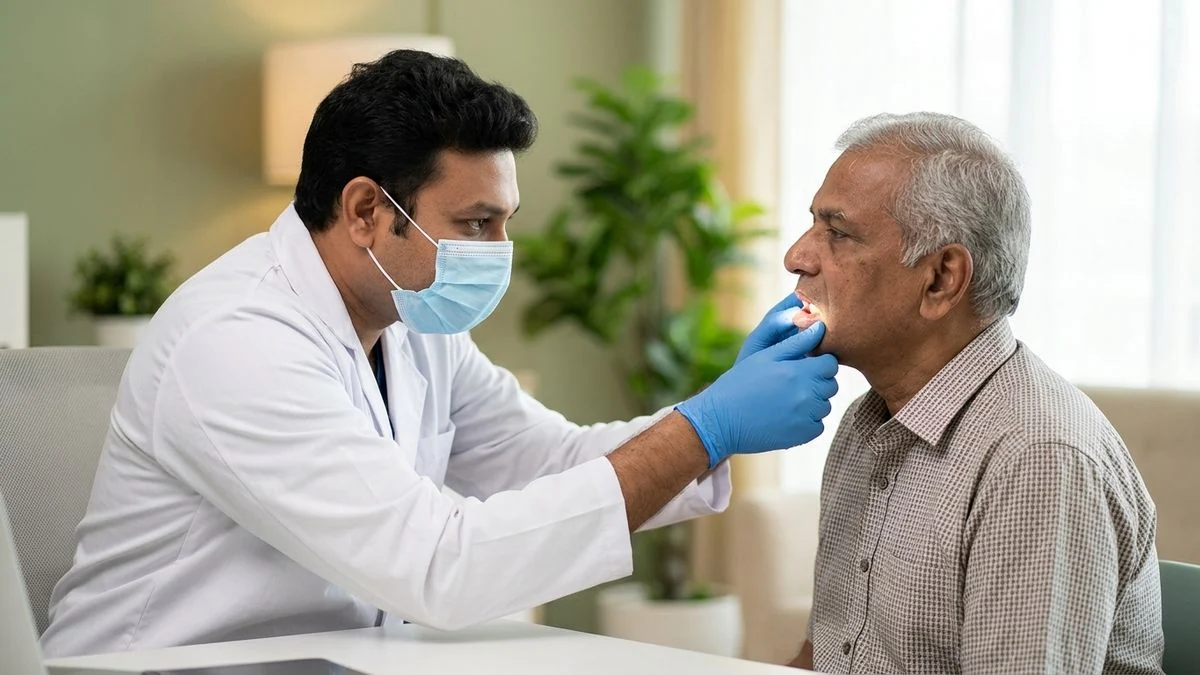
Is a Persistent Lip Sore Something to Worry About?
Discovering an unusual spot, peeling area, or sore on your lip can be concerning. Because the lips are highly visible and sensitive, changes in their texture or appearance are often noticed very early. The good news is that lip cancer is often found early because the lip is easy to see, and small lip cancers can usually be treated with a small operation that keeps both appearance and function.
Lip cancer is treated as part of our wider oral cancer treatment service. Dr. Pradeep S. and Dr. Kalpa Pandya aim to remove the cancer completely while keeping the lip able to close, so that speaking, eating and smiling are affected as little as possible.
Signs and Symptoms: Identifying a Sore on Lip That Will Not Heal
Lip cancer typically develops on the lower lip, which receives the most sun exposure. It is important to monitor the lips for any changes that do not resolve with standard lip balms or moisturizers within two weeks. Common signs that warrant a professional evaluation include:
Non-healing sore: A sore on lip that will not heal, which may crust, bleed, or weep over several weeks.
Persistent scaling: Chronic scaling, dryness, or rough crusting on the lip border that keeps returning after peeling off.
Bleeding: A localized area on the lip that bleeds easily with minimal contact or during meals.
Color changes: A distinct white or red patch on the lip, which may feel rough or sandpaper-like to the touch.
Lump or thickening: A firm lump, nodule, or thickening within the lip tissue that may or may not cause pain.
If you notice any of these symptoms, scheduling a clinical examination is the safest next step. Acting early usually means a smaller operation.
Pre-Cancerous Changes and Actinic Cheilitis Treatment
Many lip cancers develop from a pre-cancerous condition known as actinic cheilitis (AC). This condition is caused by chronic exposure to ultraviolet (UV) radiation from sunlight, which damages the cellular structure of the lip over time. AC typically presents as dry, thin, and wrinkled lips with loss of the sharp border between the red of the lip and the surrounding skin.
Seeking timely actinic cheilitis treatment is essential to prevent these abnormal cells from transforming into invasive squamous cell carcinoma (SCC). Depending on the severity of the tissue changes, treatment may involve topical therapies, laser ablation, or a surgical procedure called a vermilionectomy (lip shave). Dr. Kalpa Pandya specializes in managing oral potentially malignant disorders (OPMD) like AC, helping patients manage these changes before they progress to cancer.
A vermilionectomy removes the thin outer red layer of the lip where the sun damage sits. The inner lining of the lip is then gently advanced forward to form a new red border. The lip usually looks a little thinner afterwards and may feel numb for some weeks, but its shape and seal are preserved. Just as importantly, the whole strip removed goes to the pathologist, who can confirm whether any area had already become an early cancer.
Lower Lip, Upper Lip and What Raises the Risk
Most lip cancers arise on the lower lip. It faces the sun more directly than the upper lip, so years of outdoor work — farming, construction, fishing, driving, traffic duty — leave their mark there first. Lower lip cancers are usually squamous cell carcinomas, and many of them grow slowly from an area of actinic cheilitis that has been dry and crusted for years.
Upper lip cancers are less common and behave a little differently. Some are basal cell carcinomas that start in the skin just above the lip, and some are squamous cell carcinomas. Because the upper lip and the corner of the mouth drain to different groups of lymph nodes, we examine the neck carefully whichever part of the lip is involved.
In India, tobacco plays a large role alongside sunlight. Smoking beedis and cigarettes exposes the same spot on the lip to heat and smoke every day, and placing khaini, gutka or a betel quid in the lower lip groove damages the inner lining at that site. Other factors include heavy alcohol use, a weakened immune system (for example after an organ transplant), and long-standing white patches. Lip cancer can also occur in people who have never used tobacco — our article on oral cancer in non-smokers explains why a non-healing sore should be checked regardless of habits.
Not every white or rough spot on the lip is a warning sign. Fordyce spots, scars from biting and simple chapping are common — our guide to white spots on the lips explains which ones are harmless and which deserve an examination.
How Lip Cancer Is Diagnosed and Staged
The diagnosis is made on a small tissue sample, not on appearance alone. A punch or incisional biopsy is taken under local anaesthetic in a few minutes, and the report usually tells us the type of cancer and how deeply it has grown. Our biopsy guide explains what the procedure involves.
Size and depth: We measure the lesion, feel how thick it is, and check whether it has reached the corner of the mouth, the skin below the lip or the underlying bone.
Nerve involvement: Numbness of the lip or chin can be a sign that a cancer is tracking along a nerve, which changes how widely we need to operate.
Neck examination: We feel the lymph nodes under the chin and along the neck. An ultrasound, CT or MRI is added when the tumour is larger, deeper or close to the bone, or when a node feels enlarged.
Putting this together gives the stage, which guides how much tissue is removed, whether the neck is treated, and whether anything is needed after surgery. Our guide to oral cancer stages explains the system in plain language.
What to Expect During Lip Cancer Surgery in Chennai
Surgery is the main treatment for lip cancer. The aims are to remove the cancer completely, keep the mouth working normally and leave the lip looking as natural as possible. The plan depends on the size and depth of the tumour.
Wide Local Excision
For small and localized tumours, Dr. Pradeep S. performs a wide local excision. This involves removing the tumour along with a safe margin of surrounding healthy tissue to ensure no cancer cells are left behind. Because the lip is elastic, small defects can often be closed directly, leaving a fine scar.
Lip Reconstruction Surgery
When a larger portion of the lip must be removed, lip reconstruction is needed. Keeping lip competence, the ability to seal the lips to speak clearly, swallow and stop saliva leaking, is the priority. We use local flaps such as the Abbe, Estlander or Karapandzic flap, which rearrange nearby lip and cheek tissue so that the lip keeps as much movement and feeling as possible.
How much lip can be removed and closed directly? The lip is stretchy, and in many adults up to roughly a third of the lower lip can be removed as a V- or W-shaped wedge and stitched straight together, leaving a fine vertical scar. Beyond that, the remaining lip is too tight to close on its own and tissue has to be borrowed from nearby.
Abbe flap: A wedge of the opposite lip is swung across on a small blood vessel to fill the gap, so lip replaces lip. The two lips stay joined by a narrow bridge for about two to three weeks, after which a short second procedure divides it.
Estlander flap: Similar in principle, but used when the cancer involves the corner of the mouth. The corner is rebuilt from the opposite lip in one stage, and a small later adjustment may be offered if the corner looks rounded.
Karapandzic flap: For larger defects, the remaining lip and cheek tissue is rotated around the mouth while keeping its muscle, nerve and blood supply. Lip movement and sensation are usually preserved well, though the mouth opening becomes somewhat smaller — which mainly matters for dentures.
Very large or total lip defects: When most of the lip must go, tissue from elsewhere in the body may be needed. This free flap reconstruction is performed together with a reconstructive surgical colleague, as described on our free flap reconstruction page.
Neck Dissection if Indicated
For larger, deeper, or more aggressive lip cancers, there is a risk that cancer cells may spread to the lymph nodes in the neck. In such cases, Dr. Pradeep S. may perform a selective neck dissection to remove these lymph nodes. This treats any hidden spread and gives the pathologist the nodes needed for accurate staging.
Recovery, Rehabilitation, and Long-Term Care
Recovery varies with the extent of the operation. For the first few days you will be advised a soft or liquid diet so the healing lip is not stretched. Pain is usually controlled with standard medicines, and swelling settles over one to two weeks.
Speech and swallowing exercises may be advised after a larger reconstruction. Over several months the reconstructed tissue softens and muscle control improves.
Regular follow-up appointments are essential to monitor your healing and watch for any signs of recurrence. Patients also travel to us from other parts of Tamil Nadu, West Bengal and Bangladesh, and you can send photographs, reports and scans for a remote second opinion before you travel.
Outlook After Lip Cancer Treatment
Lip cancer is generally one of the more favourable cancers of the mouth region. Because it is visible, it is often found while still small, and small lip cancers that are completely removed with clear margins are frequently cured by surgery alone. The outlook becomes more guarded when the cancer is large, has invaded bone or nerves, or has spread to the neck nodes — which is why acting on a non-healing sore early matters so much.
When the final pathology report shows close margins, nerve involvement or affected lymph nodes, radiotherapy may be advised. This is planned and delivered by a radiation oncologist working with us; our article on radiation or chemotherapy after surgery explains when it is recommended.
Follow-up visits are usually more frequent in the first two years, when most recurrences appear, and then spaced out. Between visits, protect the lips from the sun with a lip balm containing sunscreen and a wide-brimmed hat, stop all tobacco, and report any new crust, lump or sore. Our guide to recurrence signs and follow-up lists what to watch for.
Lip Cancer Treatment in Chennai: Dr. Pradeep S. at Apollo Main Hospital, Greams Road
Your care is led by Dr. Pradeep S., an oral and maxillofacial surgeon with a fellowship in head and neck surgical oncology (FHNS), international board certification (FIBCSOMS) and more than 15 years of experience in oral cancer surgery, including three years in the Department of Head and Neck Oncology at Apollo Proton Cancer Centre. He works with Dr. Kalpa Pandya, who also manages pre-cancerous lip changes such as actinic cheilitis, and both consult at Apollo Main Hospital, Greams Road.
To discuss a lip sore or a diagnosis you have already received, call +91 96633 03747 or book a consultation for lip cancer treatment in Chennai.
Finding us in Chennai
Mouth Cancer Surgeons is the practice of Dr. Pradeep S. and Dr. Kalpa Pandya, who consult at Apollo Main Hospital, Greams Road, Chennai. Patients come to us for lip cancer treatment from across Tamil Nadu, West Bengal and Bangladesh, and we offer remote review of reports and photographs for those who need to plan travel.
Frequently asked questions
Is lip cancer curable?
In many cases, yes. Lip cancer is often found early because it is easy to see, and small cancers removed completely with a margin of healthy tissue are frequently cured with surgery alone. The chances are lower when the cancer is large, involves bone or nerves, or has spread to the neck, so a sore that has not healed in two to three weeks should be examined promptly rather than watched.
Can I get lip cancer if I have never smoked?
Yes. Long-term sun exposure is a major cause of lower lip cancer on its own, and a weakened immune system or long-standing actinic cheilitis also raise the risk. Tobacco and alcohol increase the risk further, but not using them does not rule lip cancer out. A persistent sore or crust deserves a check whatever your habits.
How much of my lip can be removed and still look normal?
In many adults up to about a third of the lower lip can be removed and closed directly, leaving a thin vertical scar and a slightly tighter lip. Larger defects are rebuilt with flaps from the opposite lip or the surrounding cheek, which use tissue of the same colour and texture. Most people adapt well; the lip may look a little smaller, and the scars usually fade over several months.
What is the primary cause of lip cancer?
The primary cause of lip cancer is chronic exposure to ultraviolet (UV) radiation from sunlight. Other significant risk factors include tobacco use, heavy alcohol consumption, and a weakened immune system. Actinic cheilitis, a sun-induced pre-cancerous condition, can also progress to lip cancer if left untreated.
How can I tell a normal cold sore from lip cancer?
A cold sore (herpes) usually starts with tingling, forms a cluster of small blisters that burst and crust, and heals completely within about one to two weeks — often returning at the same spot during illness or stress. A chapped lip improves with balm. A sore on lip that will not heal, bleeds easily, feels firm, slowly grows, or is accompanied by persistent white or red patches is concerning and should be evaluated by a maxillofacial surgeon.
Will lip reconstruction surgery change my appearance?
Any lip surgery leaves a scar and can make the lip slightly smaller. We use local flaps of lip and cheek tissue, which match the colour and texture of the lip, and aim for a natural contour and a lip that closes well.
What is lip competence and why is it important?
Lip competence is the ability to close your lips completely. It is essential for normal speech, eating, drinking, and preventing saliva from drooling. Preserving or restoring lip competence is a primary goal during lip reconstruction surgery.
How much does lip cancer treatment cost in Chennai?
The cost of lip cancer treatment in Chennai depends on the tumour size, the complexity of the reconstruction, and whether lymph node surgery or radiotherapy is needed. A small wedge excision under local anaesthetic costs far less than a staged flap reconstruction with a hospital stay. Coverage varies by insurance policy and scheme, so check with your insurer; we explain the expected treatment after your initial consultation so you can get an estimate. Our guide to [oral cancer treatment cost](/blog/how-much-does-oral-cancer-treatment) explains the factors involved.
How soon can I get an appointment or second opinion for a lip sore?
Suspected cancers are seen as a priority. Call +91 96633 03747 to book an in-person appointment with Dr. Pradeep S. or Dr. Kalpa Pandya at Apollo Main Hospital, Greams Road, or to send photographs and reports for a remote second opinion.
Is radiation therapy always required for lip cancer?
No, radiation therapy is not always required. Many early-stage lip cancers are treated successfully with surgery alone. Radiation or chemotherapy is typically reserved for advanced cases, deep tumours, or when cancer cells are found close to surgical margins or in the lymph nodes.
Who treats lip cancer at Mouth Cancer Surgeons?
Dr. Pradeep S. (Consultant, Oral & Maxillofacial Surgeon — specialist in oral, head and neck cancer surgeries) and Dr. Kalpa Pandya (Consultant, Oral & Maxillofacial Surgeon — specialist in OPMD, Facial Trauma, Dental Implants). You are cared for by the same two specialists from diagnosis through recovery.
Where do you consult in Chennai?
We consult and operate at Apollo Main Hospital, Greams Road.