
| Can Oral Cancer Be Treated Without Surgery? Surgery remains the standard first-line treatment for most operable oral cancers because it offers the highest chance of complete tumour removal with clear margins. However, selected patients — depending on tumour stage, location, overall health, and treatment goals — may be managed with definitive radiation therapy, chemoradiation (chemotherapy combined with radiation), immunotherapy, targeted therapy, or palliative care. The decision is always individualized and made by a multidisciplinary team. |
Quick Facts: Oral Cancer Treatment
| ✓ Surgery is the standard treatment for most operable oral cancers ✓ Radiation alone may be used in highly selected early-stage cases ✓ Chemoradiation is a common approach in locally advanced disease where surgery is not feasible ✓ Immunotherapy is used mainly in recurrent or metastatic oral cancer ✓ Palliative care focuses on comfort and quality of life when cure is not possible ✓ Early diagnosis significantly widens treatment options and improves outcomes ✓ All treatment decisions are individualized — no single approach fits everyone |
When a patient or their family member is first diagnosed with oral cancer, one of the very first questions I hear — almost every single time — is: ‘Doctor, is there any way to treat this without surgery?’
This question comes from a deeply human place. Fear of surgery. Fear of what a jaw or tongue operation might mean for how you speak, eat, and look. Anxiety about ICU stays and long recovery periods. A natural wish for a gentler path through a terrifying diagnosis.
I understand that fear completely. I have sat across from hundreds of patients in this exact moment — at Apollo Hospitals, Greams Road, Chennai — and answered this question honestly, carefully, and without judgment.
This article is my attempt to give you the same honest, balanced answer that I give my patients. It is not designed to push you toward surgery or away from it. It is designed to help you understand the medical picture clearly, so that you — together with your care team — can make the best decision for your situation.
1. Why Surgery Is Commonly Recommended for Oral Cancer
If you have been told that surgery is recommended for your oral cancer, it is because surgery remains the most effective way to remove the tumour completely in most situations. Let me explain why.
Oral cancers — the large majority of which are squamous cell carcinomas arising from the lining of the mouth — are solid tumours. They grow within tissue, and in many cases, they invade nearby structures such as the tongue muscle, the jaw bone, or the floor of the mouth.
Surgery allows the surgeon to:
- Remove the entire tumour under direct vision
- Achieve clear surgical margins — healthy tissue surrounding the tumour on all sides
- Send the removed tissue immediately to pathology for accurate staging
- Assess spread to regional lymph nodes through neck dissection if needed
- Plan reconstruction of the removed tissue at the same operation
In my clinical experience in Chennai, the ability to confirm clear margins pathologically is one of the most powerful advantages of surgery. We know exactly what we have removed and exactly what remains.
Radiation therapy — even at high doses — cannot always confirm this. Tumour cells can persist in tissue that appears clinically normal, and this is one reason why radiation alone achieves lower local control rates than surgery in many oral cavity cancers.
This is not to say that radiation has no role. It absolutely does. But for most operable oral cancers, surgery gives the best foundation for cure.
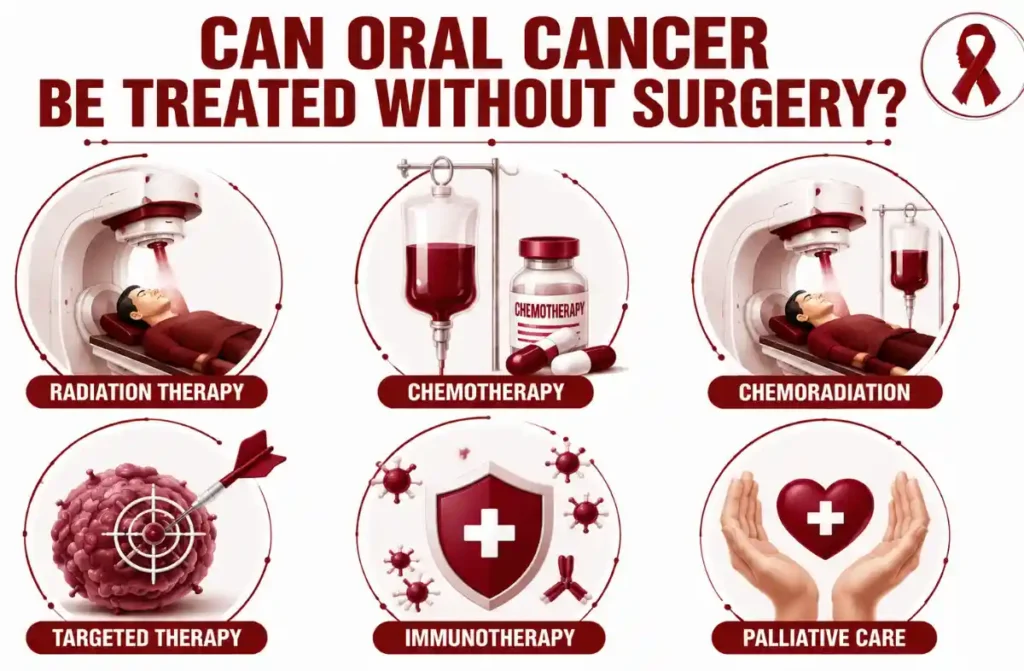
2. Can Oral Cancer Ever Be Treated Without Surgery?
Yes — in selected situations, oral cancer can be treated without surgery. But ‘selected situations’ is an important phrase.
The honest answer is that non-surgical treatment for oral cancer is appropriate in specific circumstances, not as a general alternative that can be freely chosen. Whether non-surgical treatment is suitable for a particular patient depends on:
- The stage of the cancer (early vs. advanced)
- The exact location of the tumour within the mouth
- Whether the tumour is resectable (surgically removable)
- The patient’s overall health and fitness for surgery
- The patient’s own informed preferences and treatment goals
- The availability of expert multidisciplinary care
Decisions like this are never made by a single doctor working in isolation. At Apollo Hospitals, these decisions go through a tumour board — a structured meeting of surgeons, radiation oncologists, medical oncologists, radiologists, and pathologists — where every relevant factor is weighed before a recommendation is made.
3. When Surgery May Not Be Possible
There are genuine situations where oral cancer surgery is not the right path — or is not feasible. These include:
Medically Unfit Patients
Some patients have severe heart disease, advanced lung disease, uncontrolled diabetes, or other conditions that make general anaesthesia and a lengthy operation unsafe. In these cases, the risk of surgery itself may outweigh the potential benefit.
Very Advanced or Unresectable Tumours
Cancers that have grown extensively into the skull base, surrounded major blood vessels, or invaded the prevertebral fascia may be technically unresectable — meaning surgery cannot achieve clear margins or would cause unacceptable harm. These cases require alternative treatment strategies.
Recurrent Cancer After Previous Treatment
When oral cancer returns after previous surgery or radiation, re-surgery is often technically more difficult and carries higher complication rates. In some recurrent cases, systemic therapies or palliative radiation become more appropriate.
Metastatic Disease
When oral cancer has spread to distant organs — the lungs, liver, or bones — surgery to the primary site in the mouth is rarely the priority. Systemic treatment takes precedence.
Patient Refusal
Occasionally, a patient makes an informed decision to decline surgery. In these situations, it is my responsibility to ensure they fully understand the implications, offer the best available non-surgical alternatives, and continue to support them through their chosen path without judgment.
4. Radiation Therapy Without Surgery: What It Can and Cannot Do
Radiation therapy — also called radiotherapy or RT — uses high-energy beams to damage the DNA of cancer cells, preventing them from dividing and eventually causing them to die.
When Is Definitive Radiation Used?
Radiation as the sole treatment (‘definitive radiotherapy’) may be considered for oral cancer in specific situations:
- Very early-stage tumours (T1, small T2) in patients who are poor surgical candidates
- Lip cancers in selected cases, where cosmetic and functional outcomes with radiation can be very good
- Situations where a patient makes an informed choice to avoid surgery after understanding the cure-rate differences
Advantages of Radiation Therapy
- No surgical incision or anaesthesia required
- Organ preservation — the anatomical structures remain intact
- Delivered as an outpatient treatment over several weeks
Limitations of Radiation for Oral Cancers
Here is where I need to be completely honest with you, because I think patients deserve accurate information rather than false reassurance.
- Local control rates with radiation alone are generally lower than with surgery for most oral cavity cancers
- Radiation does not allow pathological margin confirmation
- Radiation to the oral cavity carries significant side effects
- Bone damage (osteoradionecrosis) is a serious long-term risk, particularly to the jaw
- Salivary gland damage leads to permanent dry mouth (xerostomia) in many patients
- Risk of radiation-induced difficulty swallowing (dysphagia)
- Radiation damage accumulates — future surgery or re-irradiation becomes more complex
For oropharyngeal cancers (throat, base of tongue, tonsil) — especially HPV-positive tumours — radiation and chemoradiation perform extremely well and are often the preferred primary treatment. But the oral cavity (tongue, floor of mouth, buccal mucosa, gingiva, palate, lip) tends to respond less favourably to radiation alone compared to surgery. This distinction is clinically important and often not well understood by patients.
5. Chemoradiation for Oral Cancer
Chemoradiation — the combination of chemotherapy and radiation given together — is one of the most important treatment strategies in head and neck oncology today.
How Does Chemoradiation Work?
Chemotherapy drugs (most commonly cisplatin) make cancer cells more sensitive to radiation damage. When given together, the combination is significantly more effective than either treatment alone.
When Is Chemoradiation Used in Oral Cancer?
- Locally advanced cancers (Stage III or Stage IVA) that are not immediately resectable
- As post-operative (‘adjuvant’) treatment after surgery when pathology shows high-risk features such as positive margins or spread to lymph nodes
- In organ-preservation strategies for certain tumour sites
- As the primary treatment when surgery is not possible
Side Effects of Chemoradiation
Chemoradiation is effective — but it is not gentle. Patients need to be prepared for significant side effects, including:
- Severe mouth sores (mucositis) — often the most difficult immediate side effect
- Difficulty swallowing, sometimes requiring a feeding tube temporarily
- Nausea, fatigue, and weight loss
- Kidney toxicity from cisplatin
- Hearing changes
- Long-term swallowing problems (dysphagia) in some patients
Patients undergoing chemoradiation require close nutritional support, pain management, and monitoring by a dedicated multidisciplinary team throughout treatment. At Apollo Hospitals, this is managed through coordinated care between surgery, radiation oncology, medical oncology, dietetics, and speech therapy.
6. Immunotherapy and Targeted Therapy for Oral Cancer
Over the past decade, immunotherapy has transformed the treatment landscape for many cancers — and oral cancer is no exception.
What Is Immunotherapy?
Immunotherapy works by helping your own immune system recognize and attack cancer cells. In oral cancer, the most widely used immunotherapy drugs are checkpoint inhibitors — specifically PD-1/PD-L1 inhibitors such as pembrolizumab (Keytruda) and nivolumab (Opdivo).
When Is Immunotherapy Used?
Currently, immunotherapy for oral cancer is primarily used in:
- Recurrent or metastatic squamous cell carcinoma of the head and neck (R/M HNSCC)
- Cases where chemotherapy has stopped working or is not tolerated
- As part of first-line combination regimens in metastatic disease
Pembrolizumab has regulatory approval as a first-line treatment for recurrent/metastatic head and neck squamous cell carcinoma, either alone (in PD-L1-high tumours) or combined with chemotherapy. This is a genuine advancement in oncology.
Limitations of Immunotherapy
Immunotherapy is not a cure for most patients with advanced oral cancer. Response rates vary significantly. Not all patients respond. And for early-stage or locally advanced operable oral cancers, immunotherapy is not a replacement for surgery.
Immunotherapy also has its own set of immune-related side effects — including thyroid problems, inflammation of the lungs, and skin reactions — that require careful monitoring.
Targeted Therapy
Cetuximab, a drug that targets the EGFR receptor, has been used in recurrent/metastatic head and neck cancer, though its use has been somewhat superseded by immunotherapy in many settings. EGFR-targeted therapy may be appropriate in selected patients who cannot receive platinum-based chemotherapy.
7. Palliative Treatment for Oral Cancer
There are situations where the primary goal of treatment shifts from curing the cancer to controlling its symptoms and preserving quality of life. This is palliative care — and it is not giving up. It is a highly skilled, compassionate form of medicine.
When Is Palliative Care the Focus?
- Advanced, unresectable tumours that cannot be cured with available treatments
- Metastatic disease where systemic cure is not achievable
- Patients who are too unwell to tolerate aggressive treatment
- Patients who have chosen comfort-focused care after understanding their options
What Does Palliative Treatment Include?
- Pain management — oral cancer can cause significant pain, particularly when it involves bone or nerves; this is taken seriously and managed actively
- Palliative radiation — shorter courses of radiation to shrink the tumour and control pain, bleeding, or airway obstruction
- Nutritional support — nasogastric feeding or PEG tubes when swallowing is severely compromised
- Bleeding control — local packing, palliative radiation, or vascular procedures when tumour bleeding occurs
- Psychological and emotional support for the patient and family
- Oral hygiene support — crucial in oral cancer patients to prevent infection and discomfort
Palliative care does not mean withdrawing from the patient. It means focusing all our medical skill on what matters most to that person at that stage of their illness. At Apollo Hospitals, our multidisciplinary palliative care team is an integral part of oral oncology management.
8. Can Early-Stage Oral Cancer Be Treated Without Surgery?
Early-stage oral cancer — typically T1 or small T2 tumours without lymph node involvement — has the best outcomes with any treatment. But does that mean surgery can be avoided?
For most early-stage oral cancers, surgery remains the preferred approach. Here is why:
- Surgery for early oral cancer is often a relatively limited procedure — a wide local excision — that can be performed with minimal functional impact
- Cure rates with surgery for T1 oral cancers can exceed 80–90% in carefully selected patients
- Surgery allows pathological confirmation of clear margins
- Surgery avoids the cumulative toxicity of radiation to the oral cavity
Radiation alone for early oral cavity cancers is generally reserved for patients who genuinely cannot undergo surgery. In India, including in my experience in Chennai, a significant proportion of oral cancers present with buccal mucosa involvement — a subsite where radiation tends to perform less well than surgery.
That said, every patient is different. There are early-stage situations — particularly lip cancers or very small tongue cancers in elderly patients with medical comorbidities — where radiation may offer an excellent outcome with less procedural risk. The decision is always individualized.
9. The Risk of Delaying Surgery: What Patients Need to Know
Patients sometimes delay surgery while exploring alternatives, seeking second opinions, or hoping their condition will stabilize. I understand why this happens. But I feel it is important to explain, calmly and clearly, what happens when oral cancers are left untreated or undertreated.
Tumour Progression
Oral cancers grow. What is a small, surgically removable tumour today may grow to involve the jaw bone, the floor of the mouth, or the tongue base within weeks to months. This progression changes what surgery is technically possible and what the functional outcome of surgery will be.
Bone Invasion
Once a tumour invades the jaw bone (mandible or maxilla), surgery must include partial removal of the jaw. This is a much larger operation with greater functional and cosmetic impact than removing a small soft-tissue tumour. Early cancers rarely require jaw resection.
Lymph Node Spread
Oral cancers spread to regional lymph nodes in the neck. The larger and more advanced the primary tumour, the higher the risk of nodal spread. Once cancer spreads to multiple nodes, or breaks through the node capsule, the overall prognosis worsens significantly.
Reduced Treatment Options
A tumour that is resectable today may become unresectable with delay. A patient who is fit for surgery today may become less fit over time. Delaying treatment does not preserve options — in most cases, it reduces them.
I share this not to create fear, but because I believe patients deserve clear information about what is at stake in the decision they are making.
10. Common Myths About Oral Cancer Treatment
Misinformation about oral cancer is widespread — particularly on social media, WhatsApp groups, and from well-meaning relatives. Let me address some of the most common myths I encounter.
Myth: A biopsy will spread the cancer
This is false. A biopsy is a small diagnostic procedure that samples tissue for pathological examination. There is no credible scientific evidence that a properly performed biopsy causes tumour spread. Without a biopsy, treatment cannot begin.
Myth: Radiation is always safer and gentler than surgery
This is not accurate. Radiation therapy for oral cavity cancers carries significant short-term and long-term side effects, including severe mucositis, dry mouth, difficulty swallowing, and risk of radiation-induced bone damage. Neither treatment is universally ‘gentler’ — they carry different risk profiles that must be weighed carefully.
Myth: Alternative medicine or herbal remedies can cure oral cancer
There is no scientific evidence that any herbal, homeopathic, or alternative therapy can cure oral cancer. Tumours continue to grow while patients delay evidence-based treatment. By the time some patients arrive at our centre having pursued alternative therapies, their cancers have grown substantially and their options have narrowed. I have seen this pattern repeatedly, and it is one of the most difficult conversations in our specialty.
Myth: Laser treatment can remove all oral cancers
Laser surgery is a useful tool for very small, superficial lesions — precancerous lesions and selected very early cancers. It is not appropriate for the majority of oral cancers, which require proper surgical excision with margin assessment.
Myth: Surgery always causes facial disfigurement
Modern oral cancer surgery, particularly at specialized centres, includes reconstruction planning from the very beginning. Small tumours often require no reconstruction at all. Larger resections can be reconstructed using sophisticated techniques including microvascular free flaps, virtual surgical planning, and patient-specific implants. The goal of surgery is always to maximize both cure and quality of life.
11. How Doctors Decide the Best Treatment Plan
The decision about how to treat an oral cancer patient is never made by a single doctor in isolation. At Apollo Hospitals, Greams Road, every oral cancer patient is discussed at our multidisciplinary tumour board — a structured meeting that brings together:
- Oral and maxillofacial surgeons / Head and neck surgeons
- Radiation oncologists
- Medical oncologists
- Diagnostic radiologists
- Pathologists
- Reconstructive surgeons
- Nutritionists and speech therapists
The factors that shape every treatment recommendation include:
- Biopsy results — confirming the type and grade of cancer
- Imaging — CT, MRI, and PET-CT to assess tumour size, bone involvement, nodal spread, and distant metastases
- Clinical stage — using the AJCC/TNM staging system
- Tumour location and sub-site within the oral cavity or oropharynx
- Patient performance status — how fit the patient is for treatment
- Patient age and existing medical conditions
- Patient preferences and treatment goals
- Reconstruction feasibility and functional expectations
This process is what ‘individualized treatment’ actually means in practice. It is not a vague phrase — it is a structured, evidence-based process that considers every relevant factor before a recommendation reaches the patient.
12. Questions to Ask Before Deciding Against Surgery
If you are considering declining surgery for oral cancer, these are the questions I would encourage you to ask your treating team honestly — and to receive honest, complete answers to:
- What is the expected cure rate with surgery compared with non-surgical treatment for my specific tumour?
- What are the functional outcomes expected with each option — how will it affect my speech, swallowing, and eating?
- What is the risk of local recurrence with radiation compared with surgery?
- If non-surgical treatment fails, can I still have surgery? And what would that surgery involve at that stage?
- What are the long-term side effects of radiation to the oral cavity?
- What nutritional support will I need during chemoradiation?
- What rehabilitation will I need — speech therapy, swallowing therapy?
- How will my quality of life compare in the first year and in the long term?
These questions do not have simple answers. But any experienced multidisciplinary team should be able to walk you through the evidence honestly. If you feel you are not receiving complete information, a second opinion from a specialized oral cancer centre is entirely appropriate and something I encourage.
About the Author
Dr. Pradeep S., MDS
Oral & Maxillofacial Surgeon | Fellow – Head & Neck Oncology
Apollo Hospitals, Chennai
Dr. Pradeep S. is an Oral & Maxillofacial Surgeon practicing at Apollo Hospitals, Chennai, with a special interest in oral cancer surgery and head & neck oncology. He evaluates and treats patients with cancers of the tongue, buccal mucosa, gingivobuccal complex, and other oral cavity sites, as well as precancerous oral conditions.
His clinical work includes oncologic resection of oral tumors, neck dissection for lymph node involvement, and multidisciplinary management of oral cancer in collaboration with oncology, radiation therapy, and reconstructive surgery teams. Dr. Pradeep is actively involved in oral cancer awareness, early detection initiatives, and patient education, with a focus on promoting early diagnosis and improving treatment outcomes.
Clinical Focus
- Oral cancer diagnosis and surgical management
- Tongue cancer and buccal mucosa cancer
- Neck dissection for oral cancer
- Management of oral potentially malignant disorders
- Early detection and screening of oral cancer
Hospital Affiliation
Apollo Hospitals, Chennai
Medical Review
This article has been medically reviewed for clinical accuracy by Dr. Pradeep S., Oral & Maxillofacial Surgeon at Apollo Hospitals, Chennai.
Last medical review: May 2026
Medical Disclaimer
This article is intended for general patient education and does not constitute medical advice. The information provided is not a substitute for a clinical evaluation by a qualified surgeon or physician. If you have concerns about a mouth ulcer or any oral symptom, please seek an in-person assessment from an appropriately trained clinician
References:
- Shah JP, Gil Z. Current concepts in management of oral cancer — surgery. Oral Oncology. 2009;45(4–5):394–401. doi:10.1016/j.oraloncology.2008.05.017.
- Sher DJ, Thotakura V, Balboni TA, et al. Treatment of oral cavity squamous cell carcinoma with chemoradiation: outcomes and patterns of failure. Head Neck. 2011;33(12):1740–1745. doi:10.1002/hed.21675.
- Bernier J, Domenge C, Ozsahin M, et al. Postoperative irradiation with or without concomitant chemotherapy for locally advanced head and neck cancer. N Engl J Med. 2004;350(19):1945–1952. doi:10.1056/NEJMoa032641.
- Cooper JS, Pajak TF, Forastiere AA, et al. Postoperative concurrent radiotherapy and chemotherapy for high-risk squamous-cell carcinoma of the head and neck. N Engl J Med. 2004;350(19):1937–1944. doi:10.1056/NEJMoa032646.
- Burtness B, Harrington KJ, Greil R, et al. Pembrolizumab alone or with chemotherapy versus cetuximab with chemotherapy for recurrent or metastatic squamous cell carcinoma of the head and neck (KEYNOTE-048): a randomised, open-label, phase 3 study. Lancet. 2019;394(10212):1915–1928. doi:10.1016/S0140-6736(19)32591-7
- Chronopoulos A, Zarra T, Ehrenfeld M, Otto S. Osteoradionecrosis of the jaws: definition, epidemiology, staging and biology. Oral Oncol. 2018;80:48–57. doi:10.1016/j.oraloncology.2018.03.012.
Amin MB, Edge SB, Greene FL, et al., eds. AJCC Cancer Staging Manual. 8th ed. New York: Springer; 2017. (Chapter: Oral Cavity)